English

Current position:Home > News & Events > News
Why MBBR Bio Media Is a Top Preferred Choice for Modern RAS Projects 2026
Why MBBR Bio Media Is a Top Preferred Choice for Modern RAS Projects 2026
In modern Recirculating Aquaculture Systems (RAS), water quality is not just a factor—it is the foundation of profitability. Every critical metric that determines farm success, from fish health and feed conversion ratio (FCR) to growth rates and survival rates, directly depends on a stable, efficient, and reliable biological treatment system.
This is precisely why MBBR (Moving Bed Biofilm Reactor) bio media has emerged as the fastest-growing and most preferred biological filtration solution for RAS projects across the globe. As aquaculture operations continue to scale up and intensify, traditional biofiltration methods are struggling to keep up with the demands of high-density fish farming.
The Critical Challenge of Ammonia Removal in RAS
The single biggest operational challenge in any RAS environment is the continuous accumulation of toxic nitrogen compounds, primarily ammonia nitrogen (NH₃/NH₄⁺) from fish waste and uneaten feed.
Even low concentrations of un-ionized ammonia (NH₃) can cause significant stress to fish, leading to reduced appetite, impaired growth, and increased susceptibility to diseases. Higher concentrations can result in mass mortality and catastrophic financial losses. Similarly, nitrite (NO₂⁻), an intermediate product in the nitrification process, is highly toxic to fish as it binds to hemoglobin and prevents oxygen transport in the blood.
Without an efficient biological filtration system to convert these toxic compounds into harmless nitrate (NO₃⁻), even the most advanced RAS facilities will fail.
How MBBR Bio Media Solves the RAS Filtration Problem
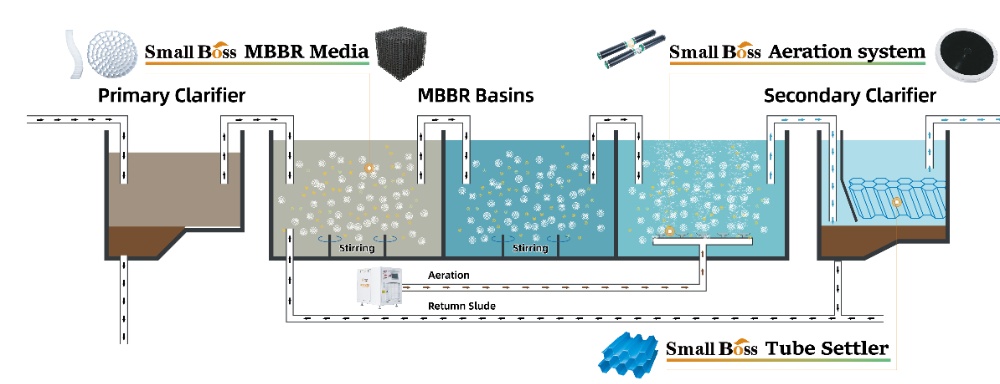
MBBR technology works on a simple yet highly effective principle: it provides a large, protected surface area where beneficial nitrifying bacteria can colonize and form a stable biofilm.
These naturally occurring bacteria perform the two essential steps of biological nitrification:
- Ammonia oxidation: Ammonia-oxidizing bacteria (AOB) convert ammonia (NH₃/NH₄⁺) to nitrite (NO₂⁻)
Nitrite oxidation: Nitrite-oxidizing bacteria (NOB) convert nitrite (NO₂⁻) to nitrate (NO₃⁻)
What sets MBBR apart from other biofiltration technologies is that the media itself is in constant motion within the reactor, driven by aeration or mechanical mixing. This continuous movement ensures optimal contact between the water, oxygen, and the biofilm-covered media, resulting in significantly higher nitrification efficiency compared to fixed-bed systems.
7 Key Advantages of MBBR Media Over Conventional Biofilter Materials
RAS designers and aquaculture engineers consistently choose MBBR bio media over traditional fixed biofilter materials (such as plastic trickling filter media, ceramic rings, or lava rock) for seven compelling reasons:
1. Exceptionally High Effective Surface Area
High-quality MBBR media offers a much larger effective surface area per cubic meter than conventional materials. SMALLBOSS premium MBBR media, for example, provides up to 800 m²/m³ of protected surface area, allowing for the growth of dense populations of nitrifying bacteria in a compact footprint.
2. Superior Biofilm Attachment and Retention
The engineered internal structure of modern MBBR media is specifically designed to promote strong biofilm attachment while protecting the bacteria from shear forces. This ensures a stable and mature biofilm that can withstand fluctuations in water flow and organic loading.
3. Unmatched Resistance to Shock Loading
RAS systems often experience sudden increases in organic loading due to changes in feeding rates, fish growth, or system upsets. MBBR systems excel in these situations because the biofilm is distributed across thousands of individual media pieces, preventing complete washout of beneficial bacteria.
4. Natural Self-Cleaning Effect
The constant movement and collision of MBBR media pieces create a natural self-cleaning effect. Excess biofilm is gently sheared off the surface, preventing the buildup of thick, anaerobic slime layers that can reduce filtration efficiency and cause odors.
5. Significantly Lower Risk of Clogging
Unlike fixed-bed biofilters, which are prone to clogging and require frequent backwashing, MBBR systems have virtually no risk of clogging. The open structure of the media and continuous movement ensure that solids cannot accumulate and block water flow.
6. Minimal Maintenance Requirements
MBBR systems require far less maintenance than other biofiltration technologies. There is no need for regular backwashing, media replacement, or extensive cleaning. This translates to lower labor costs and less downtime for RAS operations.
7. Perfectly Suited for Intensive Aquaculture
MBBR technology is ideally suited for high-density intensive aquaculture systems, where water quality must be maintained at optimal levels 24/7. The compact design of MBBR reactors allows for easy integration into existing RAS facilities and enables significant space savings compared to traditional filtration systems.
Beyond Surface Area: What Makes a Truly Great MBBR Media for RAS
While surface area is an important specification, it is not the only factor that determines the performance of MBBR media in RAS applications. A truly high-quality MBBR media must also possess:
- Optimal internal structure: A balance between surface area and water/air flow
- Precise buoyancy: Ensures uniform distribution and movement within the reactor
- Exceptional durability: Resists degradation from UV radiation, chemicals, and continuous aeration
- Consistent performance: Maintains filtration efficiency over many years of operation
Chemical inertness: Does not leach any harmful substances into the water
SMALLBOSS MBBR bio media is manufactured using high-quality virgin HDPE material and undergoes rigorous quality control testing to ensure it meets all these requirements. Our media is designed to last for more than 15 years with minimal performance degradation, making it a cost-effective long-term investment for RAS operations.
Why SMALLBOSS Is the Trusted MBBR Media Supplier for RAS Projects Worldwide
SMALLBOSS (Tongxiang Small Boss Special Plastic Products Co., Ltd.) is a leading manufacturer and supplier of high-performance water treatment products and solutions for aquaculture and industrial applications. With over 15 years of experience in the water treatment industry, we have developed a deep understanding of the unique challenges faced by RAS operators.
We offer a complete range of MBBR bio media products specifically designed for aquaculture applications, including:
- Standard HDPE MBBR media with different surface areas
- Custom-engineered media for specialized RAS systems
- Complete MBBR reactor design and installation support
Technical consultation for biofiltration system optimization
Our products are used in RAS facilities of all sizes, from small hatcheries to large commercial fish farms, across more than 30 countries worldwide. We are committed to providing our customers with the highest quality products, competitive prices, and exceptional technical support to help them achieve their aquaculture goals.
The Future of RAS Biofiltration
As the global demand for sustainable seafood continues to grow, RAS technology will play an increasingly important role in meeting this demand. As RAS projects continue to scale up and become more intensive, the need for compact, efficient, and reliable biofiltration solutions will only increase.
MBBR bio media has already proven itself as the most effective and versatile biological filtration technology available for RAS applications. With ongoing advancements in media design and system engineering, MBBR technology will continue to evolve and improve, enabling even higher stocking densities and better production efficiencies.
Final Thought
In Recirculating Aquaculture Systems, better water quality means healthier fish, higher production rates, and greater profitability. And better water quality starts with better biofiltration.
That is why more and more fish farms, hatcheries, and aquaculture engineering companies around the world are choosing SMALLBOSS MBBR bio media as the key component of their water treatment systems.
If you are planning a new RAS project or looking to upgrade your existing biofiltration system, contact SMALLBOSS today. Our team of experienced water treatment engineers will work with you to design a customized MBBR solution that meets your specific needs and budget.
Ready to improve your RAS water quality and boost your farm's profitability?