English

Current position:Home > News & Events > News
MBBR in RAS Why Biofilm Interface Oxygen Transfer Limits Performance
MBBR in RAS: Why Biofilm Interface Oxygen Transfer Limits Performance
In modern recirculating aquaculture system operations, MBBR filters are the heart of biological treatment, delivering stable water quality and reliable ammonia control. Most RAS operators keep bulk dissolved oxygen at 6–8 mg/L or higher. Even so, many systems struggle with low ammonia removal, slow response to higher feeding loads, and inconsistent nitrification efficiency—even when tank DO readings look perfect.
This gap reveals a common misunderstanding: oxygen limitation rarely happens in the bulk water. The real bottleneck is oxygen availability at the biofilm interface, where nitrifying bacteria live and work. To run your RAS efficiently, you must understand micro‑scale oxygen dynamics—especially when choosing high‑quality HDPE MBBR carrier, suspended biofilm carriers, or high‑surface MBBR media for RAS.
Bulk Oxygen vs Effective Oxygen Availability
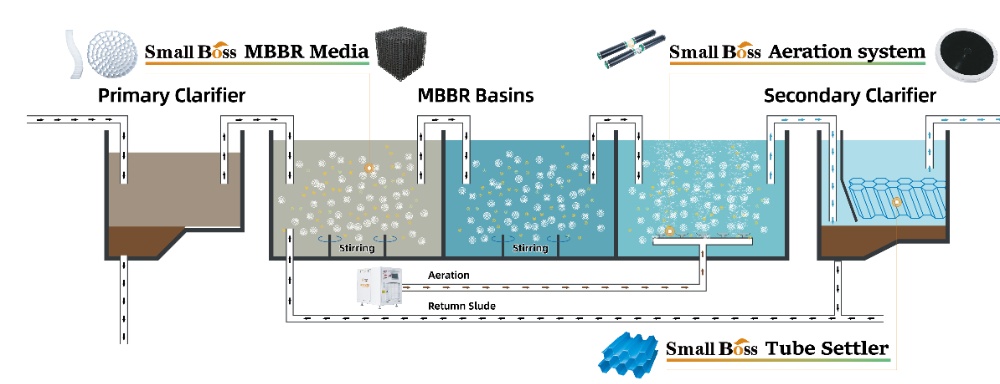
A major misconception in RAS design is equating bulk DO with oxygen available to bacteria. In an MBBR, oxygen must pass through several barriers before nitrifiers can use it:
- Oxygen dissolves from bubbles into bulk water
- Dissolved oxygen moves through the bulk liquid
- Oxygen diffuses across the stagnant boundary layer on the biofilm surface
- Oxygen penetrates into the porous biofilm matrix
- Oxygen is consumed by nitrifying bacteria inside the biofilm
The slowest, most critical step is oxygen transfer at the biofilm interface, especially diffusion through the liquid boundary layer. Even with strong aeration and mixing, a thin, stagnant water film clings tightly to aquaculture biofilter media surfaces and severely slows oxygen delivery.
The Boundary Layer: Hidden Barrier to Nitrification
The boundary layer is a thin, motionless water film that forms naturally on all submerged surfaces, including MBBR media. Its thickness directly controls oxygen flux into the biofilm—and therefore nitrification efficiency:
- A thicker boundary layer slows diffusion, starving nitrifiers of oxygen
- A thinner boundary layer speeds oxygen transfer, supporting faster, more stable nitrification
Nitrifying bacteria have high oxygen demand. As oxygen diffuses through the boundary layer and into the biofilm, it is rapidly consumed. This creates a steep oxygen gradient inside the biofilm, limiting how far oxygen can penetrate—even on premium suspended carriers.
Oxygen Penetration Depth in MBBR Biofilms
In real aquaculture MBBR operation, oxygen penetration is surprisingly limited, regardless of total media surface area:
- Only the outer 100–300 μm of the biofilm stays fully aerobic and effective for nitrification
- Below this depth, oxygen drops sharply, leaving inner layers oxygen‑limited or inactive for ammonia oxidation
- Even high‑surface MBBR media has only a thin outer zone actively removing ammonia at any time
This means selecting media based only on nominal surface area is misleading. What matters is effective aerobic surface area—the true driver of performance.
Why It Changes RAS Design & Media Selection
Traditional design relying only on bulk DO and total media surface often overestimates real performance. MBBR nitrification capacity depends on three linked micro‑scale factors:
- Oxygen flux into the biofilm (governed by boundary layer thickness)
- Biofilm thickness and density (affected by media type and hydrodynamics)
- Shear and mixing at the media surface (aeration pattern, flow, media movement)
Generic HDPE MBBR carrier with simple surfaces tends to build thick boundary layers, limiting oxygen penetration—even with high nominal surface. Engineered MBBR media for RAS with optimized shapes, textures, and porosity enhances turbulence at the biofilm interface. The result: thinner boundary layers, better micro‑scale oxygen transfer, and full utilization of the media’s nitrification potential.
Practical Implications for RAS Operators
Understanding that limitation happens at the biofilm interface (not bulk water) changes how you design, run, and troubleshoot MBBRs:
- Bulk DO is not enough: Tank DO does not reflect oxygen at the biofilm. Focus on micro‑scale oxygen dynamics.
- Optimize for the micro‑scale: Use fine‑bubble aeration, target flow velocities, and ensure full media circulation to thin boundary layers.
- Media choice is critical: Prioritize aquaculture biofilter media engineered for mass transfer, not just high nominal surface area.
Keep media moving: Ensure free circulation throughout the biofilter to avoid dead zones, maintain thin boundary layers, and prevent over‑thick biofilm.
Conclusion
In well‑aerated recirculating aquaculture system, oxygen is almost never limited in the bulk tank. The real constraint is oxygen transfer at the biofilm interface—the micro‑environment where nitrification occurs. Bulk DO and total media surface are poor predictors of actual MBBR results.
Consistent, efficient nitrification comes from optimizing oxygen flux into the biofilm, controlling biofilm thickness, and choosing high‑quality HDPE MBBR carrier and MBBR media for RAS designed for superior micro‑scale mass transfer. Focus on biofilm interface dynamics, and you will build more reliable systems, fix underperforming filters, and select the right aquaculture biofilter media for stable year‑round performance.
Get Expert MBBR Media Support for Your RAS Project
If you are looking for reliable MBBR media for RAS, professional system design, or HDPE MBBR carrier recommendations tailored to your stocking density and water quality goals, our team is here to help. Contact us today for free technical consultation, detailed product specifications, and competitive pricing. Together we can maximize nitrification efficiency and build a stable, profitable recirculating aquaculture system.